
Bali villa build budgets in 2026: what actually moves the number
People who ask how much does it cost to build a villa in bali usually want a single headline figure. That is not how Bali construction pricing works in practice. Hard-build rates matter, but size, finish grade, pool and outdoor works, site access, and the permit stack often move the total more than the contractor’s m² quote. This is a 2026 owner check — not a contractor tender and not personalised legal, tax, or investment advice.
We publish more on finished villas than on greenfield quotes. Where we cite a construction band below, it is market orientation from a live Solar EN page. Soft costs and contingencies stay qualitative unless a live Solar page already states a number. For finished stock instead of a new build, start with buy villa in Bali 2026 and the /investment/ hub.
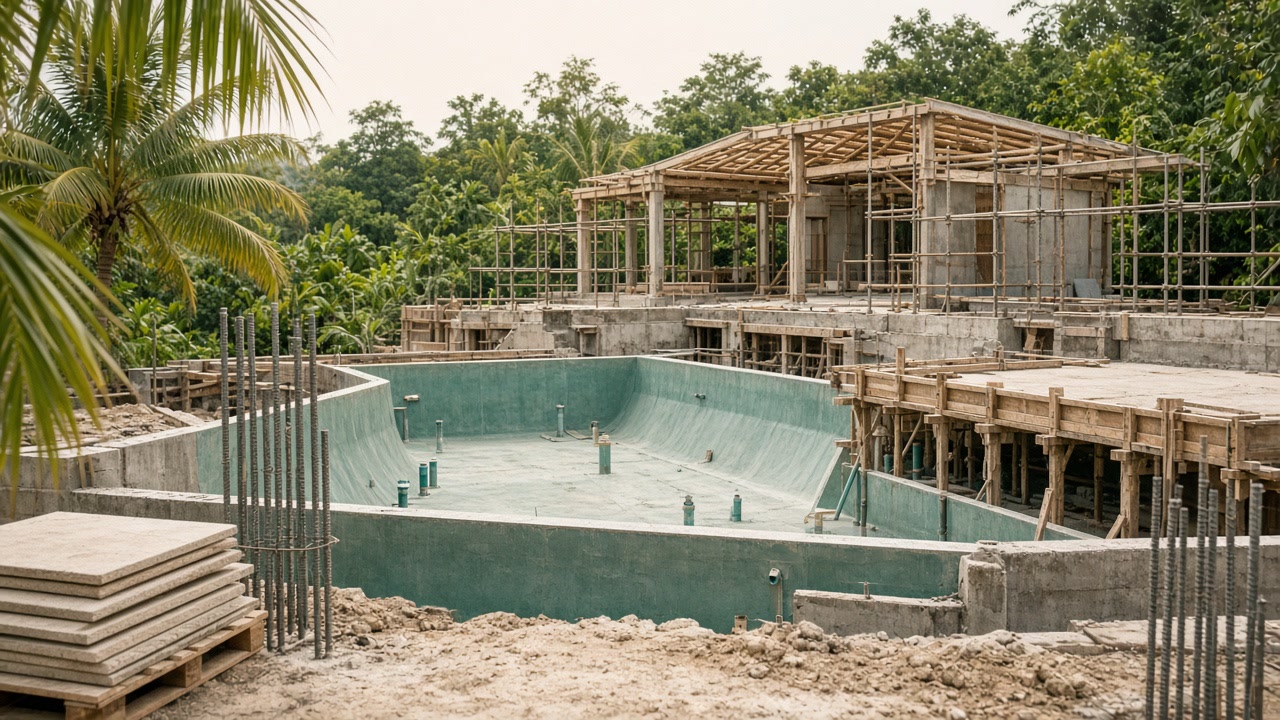
Build new vs buy finished — keep the two ledgers apart
Build new means land or lease rights first, then design, permits, construction, fit-out, and a long stretch with no rental history. You control layout — and you carry schedule risk, change orders, and permit mismatch until SLF and operating licences match the finished asset.
Buy finished means you pay for a standing villa (often leasehold) with known bedrooms, pool, and documents you can verify. You trade design freedom for faster diligence and, when the file is clean, earlier use or income. That is a different product from a build budget.
If your real question is closer to average villa price in Bali for ready stock, treat that as a buy-side band — not a construction estimate. Live Solar leasehold notes place smaller emerging-area entries from about IDR 2.5 billion (~USD 150,000) for illustrative one-bedroom examples, with Canggu / Pererenan two-bedroom pool villas commonly discussed in much higher leasehold bands (see the leasehold vs freehold guide). Those figures are acquisition orientation for marketed villas, not “build cost = sale price.”
The one construction band Solar already states
On Solar’s live Canggu villa rental guide 2026, construction costs for quality builds are framed at roughly USD 600–900 per square metre. That line is a supply-floor observation there — expensive enough to slow careless new inventory — not a turnkey villa package.
Read it narrowly:
- It is a quality-build construction orientation, not land, lease premium, furniture, landscaping, or a guaranteed tender on every plot.
- Cheaper shells and luxury finishes both exist island-wide. Solar does not publish a full build matrix on EN pages, so we do not invent one here.
- Multiply by enclosed floor area only after your architect defines what counts as m² (conditioned rooms vs outdoor living, service areas, carport). Ambiguous scope is how “cheap per m²” becomes an expensive surprise.
Everything else in a realistic owner budget sits outside that shell rate.
What actually drives the budget
Size and programme. Bedroom count is the marketing label; enclosed area, circulation, staff quarters, and covered outdoor space move cost. Freeze guest capacity and owner-use nights before drawings.
Finish grade. Same footprint, different stone, joinery, glazing, and MEP can swing the build more than another half-bedroom. Rental-ready villas need durable wet areas and serviceable plant rooms — not only Instagram surfaces.
Pool and outdoor works. Pools, decks, retaining walls, drainage, and landscaping are often under-budgeted relative to the house shell. Excavation access, soil, and setbacks can dominate early cash even when the plan looks modest.
Access and logistics. Narrow lanes, shared access, steep plots, and long material carries raise labour days. A “cheap” parcel with poor truck access can erase the discount in logistics alone.
Permits and approved use. Building without a clear path to PBG (or valid legacy IMB), then SLF, plus spatial conformity for intended use, is deferred risk — not a saving. Reconcile drawings, permits, and OSS licensing with the PBG and SLF due diligence 2026 checklist before you treat a contractor quote as investable.

Soft costs owners forget until cash is committed
Keep these as separate lines even when Solar does not publish a fixed greenfield dollar table:
| Soft / adjacent cost | Why it belongs on the sheet |
|---|---|
| Design & engineering | Architecture, structure, MEP, pool — incomplete docs create site improvisation |
| Surveys & soil | Boundary, topography, geotech where relevant |
| Permit & authority path | PBG/SIMBG process, spatial checks, later SLF |
| Legal / structure | Lease or company path for land rights; independent counsel |
| Utilities & infrastructure | Power, water, wastewater, internet — plot-dependent |
| Temporary works | Fencing, storage, site security during build |
| FF&E / soft fit-out | Often omitted from “build” quotes; rental launch needs usable inventory |
| Pre-opening ops | Staff, snagging, photography, listing setup if income is the goal |
| Contingency | Change orders, price movement, weather, drawing revisions |
Live Solar buyer pages already flag independent legal review on finished deals around USD 1,500–3,000 for thorough single-property work, and standard PPAT leasehold fees around IDR 5–15 million — a reminder that professional fees are real money (investment guide, leasehold guide). Greenfield usually needs more technical review, not less; get project-specific quotes.
Contingencies and schedule (operator framing)
Expensive failures are predictable: scope drift after PBG drawings freeze; as-built villa that no longer matches approved drawings; lease or land paid upfront then many months of build with no revenue; and launching as if you already have review history. Solar’s Canggu supply note: new stock often needs 6–12 months post-opening to compete on reviews.
Keep a visible contingency and refuse to spend it on upgrades until structure and waterproofing are secure. If the model only works with zero contingency and peak-season ADR forever, the model is the risk.
When buying finished stock is cleaner
Choose buy finished when you need evidence faster than a site diary: remaining lease years, extension language, zoning, PBG/SLF alignment, and (if income matters) booking history. Use the buy process page — do not rebuild that checklist here. Choose build when layout control on a specific plot outweighs time-to-income and permit complexity — after counsel confirms you can hold and use the land rights for the intended model (leasehold guide).
Finished inventory sits under /investment/ and the live properties for sale board. Structure still comes first: foreigners do not place Hak Milik in a personal foreign name.
Practical checklist before you sign a build contract
- Confirm land rights (lease term, build rights, rental-use permission) with independent counsel.
- Confirm spatial fit for the intended villa use on that exact parcel.
- Lock a drawing set you will permit — then price that set.
- Separate quotes: shell, pool & outdoor, MEP, interiors/FF&E.
- Map PBG → construction → SLF → OSS before groundbreaking (PBG/SLF guide).
- Tie payment milestones to inspected stages.
- Keep contingency and a schedule buffer; assume no rental income until soft opening is real.
- If you need an income asset tomorrow, shortlist buy-side stock (buy villa in Bali 2026).
Bottom line
There is no honest single island-wide villa build cost without scope. The only construction orientation Solar currently states on a live EN page for quality builds is about USD 600–900 per m² — shell-oriented market context, not a turnkey invoice. Land or lease, design, permits, pool, access, FF&E, and contingency sit on top. For many owner–operators in 2026, comparing that full stack to a diligence-ready finished leasehold is the real decision — not chasing the lowest m² rumour on a group chat.
Comparing a Bali build budget to finished stock?
Separate shell cost from land, permits, and contingency, then review curated villas on Solar Property Bali.